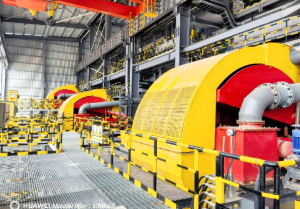
Ilmenite, as the core mineral for extracting titanium, directly impacts the raw material supply for high-end industries such as metallurgy, chemicals, and aerospace due to its separation efficiency. Magnetic separation, leveraging the weak magnetic properties of ilmenite, has become the core technology for its separation. After years of industrial iteration, several mature magnetic separation process systems have been developed. The following section will provide a detailed analysis of the mainstream processes, application cases, and technological advantages.
I. Basic Prerequisites for Ilmenite Magnetic Separation Process
Ilmenite, with the chemical formula FeTiO3, theoretically contains 52.66% TiO2 and 47.34% FeO. Its weak magnetic properties are the core basis for magnetic separation. This ore has a Mohs hardness of 5-6.5, a specific gravity of 4-5, which is iron-black or steel-gray in color with a metallic to submetallic luster. These physical properties provide a fundamental reference for particle size classification and equipment adaptation during magnetic separation. Based on this key characteristic of weak magnetic properties, various strong magnetic equipment combined with auxiliary processes constitute the mainstream technical solution for ilmenite beneficiation.
II. Four Mainstream Magnetic Separation Processes andtheIndustrial Applications
(a) Strong Magnetic Separation + Flotation Process
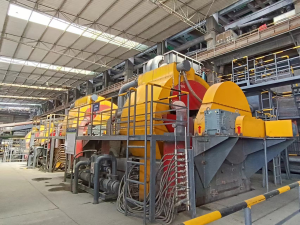
This is currently the most widely used core process, and its high efficiency has been verified by the practices of many leading enterprises. Panzhihua Iron & Steel Mining Co., Ltd. initiated its titanium beneficiation capacity expansion and renovation project in 2008, and in 2009, it built the first “two-stage strong magnetic field + flotation” production line in China. This project won the first prize of Sichuan Provincial Science and Technology Progress Award in 2011. After the renovation, the raw ore processing capacity reached 7.5 million tons/year, with an annual output of over 600,000 tons of titanium concentrate, and the TiO2 grade of the concentrate remained stable at 47.00%.
Longbai Sichuan Mining & Metallurgy has equipped its facility with 14 SLon-4000 VPHGMS, combined with LIMS and flotation mechanisms to form a separation system. This synergistic effect of the equipment has significantly improved the recovery efficiency of fine-grained ilmenite. Chongqing Iron & Steel Xichang Mining has optimized its fine-grained ammonia leaching operations, upgrading the single-stage separation to four stages, steadily increasing its raw ore processing capacity to over 2.2 million tons. Panzhihua Xingmao Company uses 3 SLon-4000 and 4 SLon-2500 VPHGMS, with a single unit processing capacity of 350 t/h and a rated excitation power of only 102 kW. The TiO2 grade of the concentrate reaches 47.02%, resulting in an annual increase of 270,000 tons of high-quality titanium concentrate.
(b) Strong Magnetic Separation + Gravity Separation Process
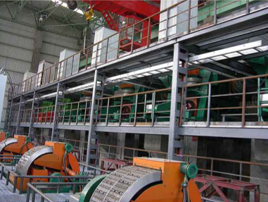
This process is suitable for multi-size ilmenite beneficiation, with representative companies including Panzhihua Zhonghe Mining and Hehui Industry & Trade. The core of the process is to first separate the ore into coarse and fine particles, then perform strong magnetic separation separately, followed by grinding and a “coarse-scan” process to enhance separation. Some private enterprises initially focused on iron ore beneficiation and spiral titanium beneficiation processes, but later introduced a combination of strong magnetic separation and gravity separation, significantly improving the recovery rate and grade of titanium concentrate.
(c) Strong Magnetic Separation for Coarse Particle Pre-selection Process
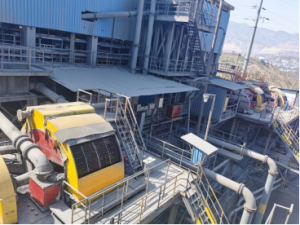
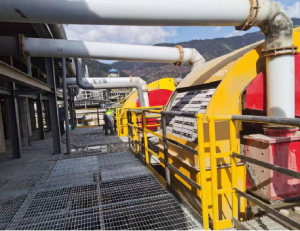
The application by Xinjiang Yunshengtong High-Tech Development Co., Ltd. is of benchmark significance. The concentrator adopts large-particle pre-selection and tailings disposal, followed by fine crushing (-6mm) and then LIMS for iron weak magnetic separation and SLon VPHGMS tailings disposal. The tailings index (TiO2 grade of about 1.5%) is basically consistent with the conventional particle size, which can significantly reduce the amount of subsequent processing and production costs, which is especially meaningful for concentrators with low-grade raw materials and good monomer liberation.
(d) Total Tailings Full-size Recycling Process
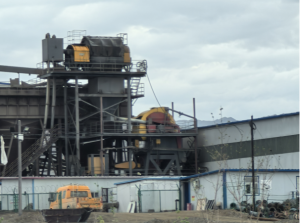
The concentrator adapts the large-particle pre-selection and tailings disposal process. After fine crushing (-6mm) and LIMS for iron weak magnetic separation, the tailings are further processed by SLon VPHGMS, followed by the “rougher-scavenger-cleaner” process. With a TiO2 grade of approximately 4%, the concentrates with a grade of 12% can be obtained. The strong magnetic separation tailings grade is controlled below 3%, laying the foundation for subsequent flotation optimization. This process marks the first application of three SLon-5000 VPHGMS, promoting the large-scale development of coarse-particle separation equipment.