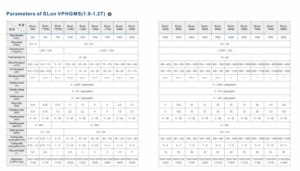
Large volume industrial solid waste of red mud is generated during alumina production by the Bayer process. Red mud features fine particles, severe argillization and complex mineral composition. Its main iron bearing minerals are hematite and goethite, accompanied by aluminium, silicon, calcium, titanium and other components. Iron minerals occur in fine grained disseminated form, and part of iron exists in other minerals via isomorphism, resulting in difficult separation. Direct stockpiling of red mud not only occupies extensive land, but also causes ecological risks due to alkali liquor leakage. Nevertheless, its abundant iron components are valuable for resource recovery. Boasting outstanding separation performance for fine grained weakly magnetic minerals, SLon vertical ring pulsating high gradient magnetic separators (SLon VPHGMS) have been industrially deployed in multiple domestic red mud iron recovery production lines and become key equipment for iron resource recovery from red mud.
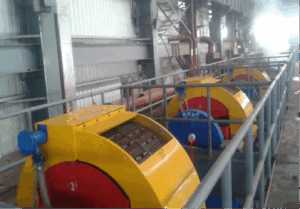
The total iron grade of Bayer process red mud from a company in Shandong is approximately 20 %. A direct magnetic separation flowsheet of “one roughing one scavenging” using SLon VPHGMS is adopted. After pulp conditioning and desliming, red mud is fed to magnetic separation operations. Concentrate undergoes desliming and dry stack dewatering to produce iron concentrate. Tailings are classified to separate coarse sand tailings and fine slime tailings for split stream disposal. Finally, iron concentrate with total iron grade of around 50 % is obtained with an iron recovery of about 40 %, yielding over 500 000 tons of iron concentrate annually.